Wednesday, March 30, 2011

SPRING IN DONEGAL

... AND THE WELSH CONNECTION

On Saturday we got out and about with our cameras for the start of spring in Ireland.  I just love spring.  Everything is so new and fresh and new life is budding and popping up everywhere.

Daffodils glowing in the spring sunshine

The day was glorious with blue skies and sunshine and all around were signs of spring: fields filled with new born lambs bouncing around, watched over by their plump mothers not yet divested of their heavy winter coats; the sunshine yellow of daffodils dotting roadsides and hillsides glowing against the budding greenery; the sun lighting up the beautiful scenery like some celestial spotlight; and the fresh, warm breeze blowing gently.

Sheep protecting their lambs
Most of the sheep we saw seemed to have twin lambs but in one field we saw three sheep surrounded by three lambs a piece.  Twin lambs are cute but triplet lambs are even cuter.  Two of the sheep were a different breed to what we normally see around Donegal and when we got home later I looked them up and it seems they are Balwen Welsh Mountain sheep. 

Balwen sheep and lambs
In the picture above you can see the Balwen sheep and her triplet lambs.  It looks like the mother sheep has six legs but I can assure you she had the standard four ~ the extra legs are her third triplet hiding behind mummy.

After a lovely morning and early afternoon taking photographs we returned home where I finished making the Irish Stew I had started earlier.  One of the ingredients I added toward the end of cooking was leeks.

And as I added the leeks to the Irish Stew, it occured to me that the day had had a sort of Welsh slant to it: daffodils, Balwen Welsh Mountain sheep and leeks.  Sometimes you'd just never guess where the events and sights of the day will take you!

Sunday, September 12, 2010

MOST BEAUTIFUL BEACH IN IRELAND

Donegal is home to the most beautiful beaches in Ireland and certainly home to the highest number of long stretches of sandy beaches in Ireland.

Ballymastocker Bay, Fanad, County Donegal

Indeed some years ago writers of the Observer Magazine voted the fabulous beach on Ballymastocker Bay on the Fanad peninsula of County Donegal the second most beautiful beach in the world, (pipped at the post by a beach in the Seyshells).


Ballymastocker Bay, Fanad County Donegal

The beach is huge, stretching all the way from Portsalon to the steep Knockalla coast road.  A drive, or a walk up the hairpin bends of the Knockalla coast road brings you to two viewing points from which to view this spectacular beach, the first half to two thirds of the way up and the second at the very top of the road.  From the top the views are not only spectacular but also a bit dizzying for those who have a fear of heights.

Inishowen from Knockalla coast road
And at the top of the Knockalla coast road along with viewing Ballymastocker Bay you can see all the way to another Donegal peninsual, Inishowen.

Wednesday, September 1, 2010

JAUNTS AROUND DONEGAL ~ DONEGAL BAY WATERBUS

On Monday we took the opportunity to take a trip on the Donegal Bay Waterbus, something we had long intended to do but had just never before got around to.  And am I glad we did ~ it is excellent!
The Donegal Bay Waterbus

What is the Waterbus?  Basically it is an 80' long, flat bottomed, "sea safari" vessel which takes passengers from the pier in Donegal Town out into Donegal Bay on a trip lasting approximately an hour and a half.  Boarding is a doddle ~ no climbing down pier steps or any of that scary stuff, instead there is a (carpeted if you don't mind!) gangway from the pier straight onto the bottom deck of the Waterbus.
Carpeted gangway makes for easy boarding and disembarking

We paid for our trip at the Donegal Bay Waterbus office which is located at the head of the pier on your right as you come down to the pier from the Diamond (the centre of Donegal Town). There is ample parking all along the pier but it can be busy at times and so take a while to find a space.  Once a space is found you must pay for a parking ticket at one of the ticket display units around the car park (€2.70 for the day, .30 cents per hour).

Leaving Donegal Town aboard the Donegal Bay Waterbus
The Waterbus can only go out at high tide so punctuality is vital. You must be at the Waterbus 15 minutes prior to departure time WITH your tickets ~ you cannot pay on board. Therefore you should leave at least half an hour prior to the 15 minute boarding time to allow for parking, paying for parking and purchasing your Waterbus tickets.

The open upper deck of the Donegal Bay Waterbus
There are two decks on the Waterbus, the lower one is covered in and has rows of seats, a bar, a seating area around the bar and wait for it ... a little dance floor too!  The upper deck consists of rows of open air seating.  There are ladies and gents lavatories located on the lower deck.

The lower deck on the Donegal Bay Waterbus


The Bar aboard the Waterbus
The bar on the boat is full stocked with the usual choice of spirits, beers (bottled and canned), soft drinks, tea and coffee.  The prices are on par with pub prices and maybe even a few cents less for certain things.  I noticed that the mixers for spirits were 10 cents less than we had paid in a pub the previous night.  I was pleased to see there was no rip off prices, which can be the case anywhere where there is a 'captive' audience.

We chose to sit on the upper deck so that we could maximise our photo opportunities and knowing that we would be taking many photos were happy to find two little secluded seating areas away from the main one.  These are located at the back of the main seating area and to the right and left at the top of the back stairs.

View from the "best" seats on the Donegal Bay Waterbus
Once everyone was aboard, we set sail.  The trip starts off with the usual safety talk, brought to us via the loud speakers dotted around the Waterbus and it covers such things as the location of life boats, safety jackets and so on.  After this is over and the Waterbus is heading out into the bay there is a running commentary over the loud speakers of what to look for on the trip, interjected here and there with the odd joke.  We were told to look to the right to see this, the left to see the other and so on for the whole trip out.  This was excellent as there were probably many things we might otherwise have missed.

Donegal Franciscan Abbey

The first thing you see on the trip out is the ruins of the Donegal Franciscan Friar, which on dry land you can walk up to just past the pier to the left.  The Waterbus however offers a superb view of it from the water.  To read more about the history of the Abbey and view photographs of it click HERE

Emigrant victims' memorial on the shores of Donegal Bay
Along the shore we were shown the point from which local emigrants to America would have boarded ships to leave Ireland during famine times.  I noticed a memorial near this point and after the trip asked one of the crew what it was and he told me it was a monument placed there by the people of Donegal Town to commemorate those who had died aboard the famine ships (coffin ships) which left these shores over 150 years ago.  I got directions to it and we did try to get there but the road ends and it is all walking from that point, not something I would have necessarily minded but it was the warning the man gave about cattle there who might not be so pleasant that put me off venturing further!  However, I did manage to photograph it from the boat so that will have to suffice.

The old coastguard station, Donegal Town
Before the emigrant departure point we were shown the now nearly derelict building which was once the coast guards station and later a hostel.  It is now planned to turn it into a luxury hotel with it's own marina.  What a fabulous location that will be.

Seals and their pups in Donegal Bay
The highlight, after the stunning scenery, for me was passing by, twice ~ once going out and once coming back, a colony of seals with their pups.  It was wonderful to see them in their natural habitat and at such close quarters.  Some of them almost seemed to be posing for the bank of cameras pointing at them from all the passengers! 

St. Ernan's Island and boathouse, Donegal Bay

The trip passes by the seven islands in Donegal Bay, the Green Isles as they are called.  Most are uninhabited but at least one of them is accessible by a causeway road from the mainland, that being St. Ernan's, on which there is an hotel.

Bell's Island, Donegal Bay

The views for the whole trip are spectacular and especially on a perfect sunny day like Monday was and, like us, many of the passengers spent their time taking photographs all along the way. 


View to Barnesmore Gap from the Waterbus
 On the return trip music was playing on the loud speakers and I assumed they were playing a cd until my husband went down to the lower deck to return our glass (we'd shared a Lucozade as carrying two glasses up the narrow stairs might have proven rather difficult!). He arrived back up to tell me that there was actually a man playing an organ and singing. Of course I had to see this and as we were nearly back in Donegal Town, we made our way down to the bar. It was surreal to see people, aboard a "sea safari" singing along with and even dancing to the music!

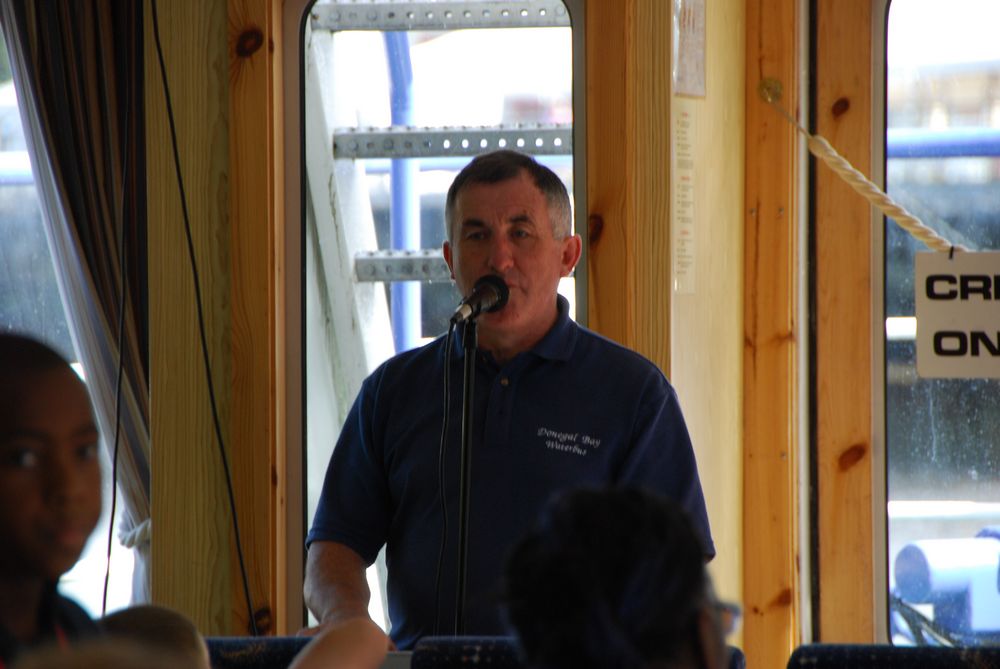
Our entertainer on the Donegal Bay Waterbus
I'd wholly recommend a trip on the Waterbus whether just to take the fresh sea air, enjoy the fabulous views or for people like us who love taking photographs.  The atmosphere on the boat is great and the staff are friendly, welcoming and helpful.  All I could hear from the passengers disembarking was "brilliant" and "fabulous" and other positive comments.  Walking back along the pier to Donegal Town I spoke with some of the other passengers and every one of them agreed it was a great trip.

THE NITTY GRITTY
NOTE: The Waterbus is dependent on tide times so it is absolutely vital you ring the Waterbus office to check the times the Waterbus will be going out.  Booking a few days in advance is probably best but even on the day you can check with the booking office for availability.

You can't pay on board so you must purchase tickets from the ticket office located at the start of the pier just down the street on the right from the centre of town.

You must have paid and parked FIFTEEN minutes prior to departure time.

PRICES (2010)
Adults ~ €15
Children (4-17 years of age) ~ €5
Student fare (must have student ID card) ~ €10
Group discounts available ~ telephone to arrange these discounts, where applicable, in advance.

To contact Donegal Bay Waterbus:

email: info@donegalbaywaterbus.com
Tel: +353 74 97 24010

To go to their website, click HERE

To view more photographs click HERE

To view a slide show of our trip click HERE

Saturday, May 29, 2010

WeLoveDonegal BACK ON LINE

29th May 2010

Our website WeLoveDonegal is now back on line so please feel free to visit us and browse the site.  Call back often as the site will be updated with new photographs and more information on a daily basis.

Thursday, May 27, 2010

MY PHOTOS OF DONEGAL

Those who read my blogs will know I'm an avid taker of photographs of Donegal.  One, I love photography with a passion, and two, I love showing people how absolutely stunning Donegal is and I can do that through showing my photographs on various sites and blogs.

So imagine my delight when I heard that the Irish Daily Mirror today had used some of my photographs of Donegal in a centre page spread they did showing photos of Ireland.  I got the paper and was even more delighted to see that out of the ten photos they printed seven, yes, seven were mine!  (To view the pics they used click on the link at the end of this post).

How's that for getting our fabulous county some coverage? 

Added to that the Democrat on Sunday this week will feature my photograph of MacSwynes Castle and bay (shown below) in a massive centre page spread.  And conincidentally, the photograph the Democrat chose is the one I chose as the header for both this blog and the all new WeLoveDonegal.com site!

MacSwynes Castle, St. John's Point, County Donegal

If the photos help bring more people here to see the county for themselves I will be delighted.  It is certainly paradise for photographers and artists and these people should beat a path up here to take advantage of our stunning scenery which in my totally unbiased opinion, is the best in Ireland.

PHOTOS USED BY IRISH DAILY MIRROR

Sunday, May 23, 2010

JAUNTS AROUND DONEGAL ~ DUNLEWY CENTRE

Sunday 23rd May 2010

Dunlewy

Today we took a trip to the Dunlewy and the Visitors Centre there ~ Ionad Cois Locha with the intention of taking their boat trip out onto Dunlewy Lake in order to get some photographs of Errigal and the surrounding countryside from the water.  I also wanted to take their 'cottage tour' to see what was inside the cottage.  I love going into these old places, seeing how life was lived many years ago.

Other than those two things I hadn't really expected to see much else but boy, was I in for a surprise.  The place was buzzing with lots of people enjoying an afternoon there.  As well as the historical interest for adults, there is lots for the children too including a mini farm with donkeys, pigs, a lamb, various birds including geese, hens, rabbits, peacock and peahen.  There's a small pond with pedallos, a climbing wall, a rodeo bull, a play area, and an indoor bouncy castle.  The farm is free to enter and there is a charge for the other attractions.  Our tour of the cottage and the boat trip came to €10 each.

The cottage and our guide, Francie Diver


The cottage tour, taken by guide Francie Diver, is of an old cottage owned in the middle of the last century by a weaver called Manus Ferry.  He lived there with his brother who took care of the sheep who provided the wool for the tweed and their sister who ran the little shop beside the cottage.  Manus' tweed weaving skills were excellent and he sold tweed to many famous people of the time including the late Tabasco Sauce millionaire,  Henry McIllhiney who at the time owned the nearby Glenveigh Castle and the Glenveigh Estate.  (Mr. McIllhiney later gifted ownership of the castle and the estate to the Irish state).  The coat woven by Manus Ferry and owned by Henry McIllhiney is on display in the cottage together with a photograph showing Mr. McIllhiney wearing the coat.

The tour starts off with a short slide show lasting about five minutes which gives a history of the area and later of the cottage and the Ferry family.  Next Francie gave a display of how raw wool was worked with and then spun on one of the two old looms there to eventually end up as bales of wool for knitting such items of clothing such as socks and jumpers.

After this display we moved on the the hand loom and the display of how the tweed was made was given, again by the multi-talented Francie.  I have to say you would need real concentration and co-ordination to work this beast of a loom but Francie made it look deceptively easy.  As he was displaying to us how the loom worked, he managed to produce about an 8" length of tweed, speaking all the way through!

Cottage interior ~ note the bed to the left of the hearth

Moving on from there we entered the cottage itself and what we would call today the living room.  Walking in the old cottage door the first thing that hits you is the heavenly smell of a turf fire.  I love that smell, evocative as it is of years gone by.  The room was typical of these old cottages in that it had an open fire with lots of crocks and pans sitting by the hearth, a bed recess, an old dresser packed with all manner of dishes including bowls from which people would drink their tea at one time.  There was the Sacred Heart picture with the little red light in front of it and even the china dogs on the mantelpiece.  An old table beside the window where the family would have eaten completed the room. 

Something very special there is an original pair of  a childs hobnailed boots in almost perfect condition.  These little boots, also called tackety boots, were handmade from leather and then had a sole of a metal plate and hobnails (flat headed nails) added in order that the boots would last longer.  If you look closely at the photograph (click to enlarge it) you can see a series of little cuts around the top of the boot.  These were done to make them more comfortable around the ankle as the leather is very stiff on them and would otherwise have cut in to the wearers flesh.  Apparently these were found by someone in an attic in nearby Gortahork and donated to the Center.

After this room we went to what would have been called 'the upper room' in days gone by, a good name as it is a room up from the main room and through a latched door to the side of the fireplace.  This room contained a bed, a small handmade wooded crib on rockers and various other bedroom paraphernalia.  The coat woven by Manus hangs on the edge of the wardrobe in this room.  If you look at the photograph to the left here, you can see the photo of Henry McIllhiney wearing the coat.

Moving back down through the living room and through a door on the opposite wall, we entered the 'lower room' or scullery/pantry and this is full of all sorts of kitchen items such as an old hand worked washing machine, pandys which were cans for holding milk and hand made by travelling tinkers of the time.  Indeed this is where the word 'tinker' came from, these travelling men fashioned all sorts of domestic items from tin and then sold them to the people whose villages they travelled through.  There is also a selection of old dishes and jugs and even an old wooden butter churn.

The old shop ~ note the plough in front of the shop

That completed our tour of the cottage and we exited out through the half door into a yard where we could see the old tin shop that the family ran.  Inside the wood lined shop there are many items still there from the days when the shop was open and the shop is more or less as it was.  On the counter there are a few old books which list what various customers bought.  I know from being in my grandparents shop here in Donegal as a child that such books were kept so the customers could collect groceries throughout the week and then pay for them at the end of the week.  The value of such books today is that they show us clearly what people bought at the time and what they paid for these items. 

Shop shelves

In the shop too there are various old 'bone-shakers', the name put on the black bikes of old.  On the counter there is a set of scales which would have been used to measure meal and flour and the like and all along the shelves behind the counter there are boxes which would have contained such things as sweets, snuff, biscuits, which were sold loose in those days.

After leaving the shop we wandered around the little farmyard for a while and then made our way down to the wooden jetty to take the boat trip.  Once on the jetty we waited with the other passengers for our 'captain' who turned out to be none other than ... yes, yet again, Francie!  Once on the boat, which is very easy to get onto as it sits right up at the jetty so you literally just step on to it, you have the choice of a couple of covered areas with lots of benches to sit in and enjoy the views from inside or alternatively, as we did, you can stand in the uncovered area.  Francie gives a running comentary on the surroundings and history of the area which is very informative.  The trip in total takes about 30 minutes and travels from the jetty at the Centre right up to just in front of the old church.

Errigal from the boat

Back on dry land, we walked back to the main building.  In here there are loos, a large gift shopping selling all manner of local crafts and gifts.  There is a cafe/diner which serves snacks and meals.  As it was nearly closing time (6pm) we didn't have time to sample the food so maybe next time. 

I think the centre is well worth a day out for both families to take their children to and also adults without children in tow.  It is rich in the history of the area but it is also a fun place for the children and we will certainly be back soon with our two older grandchildren who I know will have a ball there.

Wednesday, May 19, 2010

MAY IN DONEGAL


Mayflowers

Every month and season offers something special but for me, May in Donegal is extra special.  Placed as it is on the tail end of spring and on the cusp of summer, the month of May seems to capture the best of those two seasons.

The hedgerows are bursting with flowers, the vibrant yellow of gorse in full bloom can be seen all over the hills, and the blackthorn is in full bud just waiting blossom.  Fields and bankings are covered with primroses, daisies, buttercups, mayflowers, and many other tiny flowers.  Bees are buzzing, gathering pollen from these flowers.  Indeed they are so busy, they scarcely notice a camera getting up close to them.


In the fields too new life is all around.  Sheep, cows, horses and goats are nuturing their young in the warmth of the May sunshine.   And as we drove around last Sunday, I spotted a duck with just one little duckling following her along a little stream in the Bluestack Mountains.  It was frustrating that I didn't get to photograph them but just seeing them was special.  I am currently waiting to see cygnets and given the amount of swans we have in Donegal, I am hopeful of being able to photograph them at sometime this month.

A juvenile herring gull in Killybegs harbour

Perched up on a banking the other day, taking shots of buttercups and daisies, a scent hit me that I had not smelled for years.  Wild garlic.  I followed my nose until I found the source of the scent and there under some overgrowth I spotted the delicate little flowers of the garlic plant.  I'd love to have pulled some but I am against taking things from their place, maybe another reason I love photography: I can 'take' what I see without ever doing any damage ... take only memories (and photos!), leave only footprints.

In May a couple of years ago, driving towards Donegal Town from Rossnowlagh I saw a field full of Shetland ponies, so of course had to pull over and climb up the path to their field to photograph them.  Once there I was delighted to see a tiny foal.  It really was the cutest thing, almost like a toy rather than an actual animal.  They were a very curious bunch of ponies and came dashing over to the fence to me to pet. 

One of the prettiest young animals I have ever seen is a little Spanish donkey.  Not, I know, something one would expect to see in Donegal but a couple in Letterkenny owned it and were happy to allow me to photograph it.  He was all long legs and huge, gentle dark eyes.  And the fur on his long ears was the softest imaginable.  I would happily have taken him home with me!

I was lucky enough to see a pair of goat kids and even more lucky to get this shot of them where they almost posed for the shot.  They were in a field at the foot of Sliabh Liag (Slieve League), the highest seacliffs in Europe.  They weren't a bit bashful and happily ambled about in front of me giving me lots of time to photograph them.

Of course it's not all sunshine and blue skies in May but the rainfall is softer than earlier in the year so it never seems so bad.  I took this photo of apple blossom which is currently in bloom and I rather like the effect of the tiny drops of rain on the petals.  
So, there we are, a glimpse of the month of May in Donegal.

For more photos of May in Donegal CLICK HERE.