Showing posts with label boat trips in Donegal. Show all posts

Friday, August 26, 2011

WHY MAKE DONEGAL YOUR IRISH DESTINATION?

I decided to compare Donegal with the other tourist destinations in Ireland and I found I agreed with myself, Donegal is the best place in Ireland! 

Why?  Well the object is not to put down other areas of Ireland but rather to offer an option and show that just this one area of Ireland, County Donegal, can at the very least match the famous tourist destinations of Ireland both in beauty and magnificence.

Beautiful Donegal
Read on and take a trip with me from Dublin to Donegal and on to the Giant's Causeway and Belfast and back to Dublin to find out why and see too how your trip to Ireland could be made more compact whilst still seeing a lot of what Ireland, and Donegal, has to offer. 

So, let's begin our tour starting off in Dublin.  Spend a day in Dublin and take in The Guinness Storehouse, Kilmainham Gaol and afterwards, Glasnevin Cemetery and Museum (do the tour and see the graves of some of Ireland’s most famous men and women), the National Museum of Ireland where amongst many, many things to see you can see the uniform worn by Michael Collins, and while there don't forget to pay a visit to Croppys Acre in front of it, and of course the Book of Kells in Trinity College. Two days in Dublin will give you ample time to see all those plus some extras such as perhaps the Viking Splash Tour, or a walking tour of Dublin, or the excellent Literary Tour in the evening or for the braver and fun, the Ghost Bus Tour.

Two and a half hours will take you to Donegal and on the way you could stop off at the ancient site of Newgrange and the Hill of Tara and maybe even visit the birthplace and grave of Patrick Kavanagh.

So, let’s compare Donegal with other popular tourist destinations and things to do in Ireland.

THE BOOK OF KELLS AND DONEGAL

Birthplace of St. Colmcille
The birth place of St. Colmcille (who was involved in the worlds first every copyright case from whence the saying "to every cow it's calf" came), the famous saint whose monks later produced The Book of Kells.  In Donegal you can visit the place of his birth at Gartan and then the place he was first educated (Kilmacrennan), together with any of the many places associated with this saint in Donegal.  On the way to Donegal from Dublin you could also visit Kells where St. Colmcille founded a monastery.

THE CLIFFS OF MOHER ... OR IN DONEGAL

A section of the cliffs on Tory Island
In Donegal we have many cliffs to visit, the most famous of which are probably the cliffs at Sliabh Liag (Slieve League) which at 1,972 feet, are the highest sea cliffs in Europe and offer sensational views (and it’s FREE to visit). You could even take a boat trip from nearby Teelin and view the majesty of these cliffs from the sea below.  And speaking of boat trips you could take the ferry to the beautiful island, Tory Island, which has cliffs that are second to none in Ireland.

View from Banaba's Crown, Ireland's most northerly point
And speaking of cliffs ... there can be no better place to stand and take in the bracing Atlantic air than at Ireland's most northerly point, Banba's Head at Malin Head.   

THE BURREN ... OR IN DONEGAL

Donegal has many thousand acres of spectacular countryside unspoiled by human habitation
Donegal has many thousands of acres of unspoiled scenic landscapes, free of houses and all signs of human habitation and with stunning rock faces, mountains and valleys together with miles and miles of walking footpaths, many rare plants and a lot of species of birds.

THE LAKES OF KILARNEY ... OR IN DONEGAL

Lough Meela and Errigal and Muckish Mountains
Donegal has some of the most stunning lake views in Ireland. One part of Donegal (The Rosses) is dotted with hundreds of lakes. At Lough Salt you can stand at the viewing point and see Lough Salt, after passing Lough Dubh a few hundred yards before, and then turn and see not only three lakes behind you but also the majestic outline of Errigal, the highest mountain in Donegal and Muckish Mountain too. With the added view to your right of Ards and Downings Bay.

THE BLASKET OR THE ARAN ISLANDS ... OR IN DONEGAL

Leaving Tory Island
There are many islands off the coast of Donegal, some of which are inhabited and others from which the last inhabitants have long gone.  A regular ferry service will take you to the two main inhabited islands ~ Aranmore Island or Tory Island.  Tory Island is thought to be the first place inhabited in Ireland and has a rich and interesting history, lots of Irish musicicans and traditional artists the home of the Tory School of Art.  The late world famous artist, Sir Derek Hill loved Tory dearly, spending months there over a few decades and it is he who put the Tory artists on the map.  On the mainland Donegal you can visit the house Sir Derek gave to Ireland, Glebe House, his Irish home near Gartan.

THE VARIOUS FAMOUS CASTLES OF IRELAND ... OR IN DONEGAL

Donegal (or O'Donnells) Castle
Whilst Donegal does not have any huge tourist attraction castles to visit it does have many castle ruins dotted throughout our landscape. The main attraction in Donegal is O’Donnell’s Castle (better known as Donegal Castle) and whilst not as grand as others it has the unique benefit that those interested can also visit the place where the O’Donnell chieftains had their inaugurations from circa. 1200 AD. Or perhaps the ruins of the Franciscan monastery (Donegal Town) founded by two of the wives of these high kings. Or maybe visit the ruins of Rathmullan Friary from where the O’Donnell’s fled to Europe in 1607. Maybe you could take the time to visit Glenveagh Castle, not only rich in history but the place where the likes of Grace Kelly stayed when visiting Ireland.  Donegal is steeped in history and as a result historical sites, all worth visiting for those with an interest in such places.

THE VARIOUS HISTORICAL SITES OF IRELAND ... OR IN DONEGAL

Kilclooney Dolmen
Donegal has the only Tau Cross still in situ (Tory Island); has one of the oldest early Crosses, the Killaghtee Cross which pre-dates the early High Crosses; or the Kilclooney Dolmen which is an intact Dolmen and one of the finest examples left in Ireland. There are many such sites to visit in Donegal and more can be read about HERE.

TOURISTY, ORGANISED TRADITIONAL MUSIC NIGHTS ... OR IN DONEGAL

Traditional music in County Donegal
Traditional music forms an integral part of the Donegal experience and rather than have organised, paid for nights, here in Donegal it is possible to find groups of traditional musicians gathering in many of the small bars around the county. Most villages and towns have at least one pub where traditional music is played at least once a week. Rather than being too organised and touristy, these are gatherings of men and women who love their music and show up at appointed venues to enjoy their music and entertain those gathered there.

AND SOME MORE REASONS TO VISIT DONEGAL

Donegal Bay
Donegal not only offers all the above but we also have the largest bay in Ireland, Donegal Bay, which you have the option to enjoy by taking a short (45 minutes) boat trip on the Donegal Bay Waterbus to view in all its splendour or view from many places around south Donegal; the clearest diving waters in Europe (at St. John’s Point, the longest peninsula in Ireland); some of the best surfing beaches in Ireland and comparable with the best in Europe (Rossnowlagh, Bundoran, and more).


Ballymastocker Bay, named as one of the 10 most beautiful beaches in the world
There are miles and miles of sandy beaches sprinkled along our almost 800 miles of coastline, one of which was named one of the 10 most beautiful in the world making it the most beautiful beach in Ireland; some of the best golf courses in Ireland; horse riding; bird watching; fishing of all sorts; and maybe even catch a glimpse of the100 + pod of bottle nose dolphins around our coast ~ there are numerous boat trips to take you out into our waters to try and catch a glimpse not only the dolphins but maybe even some of the whales there.

"Surf's Up!" Donegal
We have friendly, owner run taverns and restaurants, including the Donegal Good Food Taverns, serving the best of local produce including lamb and beef reared here in Donegal together with a huge range of seafood caught along our Donegal shores. And speaking of Donegal Shores, in Donegal you are also in the birthplace of the world famous Daniel O’Donnell where you can visit the wee village of his birth, Kincasslagh.

Enjoy a bowl of Seafood Chowder in Donegal
And if music is your bag, a visit to Leo’s Tavern is a must. The “Leo” in Leo’s Tavern is the father of Moya Brennan who together with two of her brothers and two of their uncles formed Clannad and also Enya, the world renowned singer and musician. Not only is Leo’s Tavern full of memorabilia of his famous family but is a place where the visitor can enjoy a good, home cooked meal and perhaps even enjoy a bit of great traditional Irish music too.

There is of course much more to see in Donegal but this gives a tiny taste of it.  At the end of your stay in Donegal you might want to finish off your visit to Ireland with a trip the Giant’s Causeway, which whilst of course not in Donegal, remains one of the most popular tourist destination in Ireland and you are nearer to the Giant’s Causeway from Donegal than any of the other popular tourist destinations here with the added benefit that on the way you can visit the only city in Europe with its city walls still intact (and walk along them), in Derry and spend a little time in the city seeing all it has to offer.  You can even take a sea trip to from Donegal to Derry by taking the ferry which leaves Greencastle in Inishowen over to Magilligan in County Derry and on from there to Derry city.

Or maybe enjoy a visit to the Ulster American Folk Park, Omagh, a living museum which deals with the mass emigration experience in Ireland during the famine, and where the visitor can walk through an Irish village of that time, board a famine ship and disembark in the America of that time, visiting shops and houses on both sides with actors playing the parts of the people of the time.

Afterwards, travel along the scenic countryside and visit Dunluce Castle then perhaps stopping off at the famous Bushmills Whiskey Distillery on the way before arriving at the Giant’s Causeway.  You can then drive along the beautiful Antrim coast to Belfast and take in the sights of Belfast.  At the end of this journey you are travelling home out of Dublin? Belfast to Dublin is just a short two hour drive now.  Alternatively you could travel from Donegal, visiting these places and back to Donegal in the one (long) day.

Statue of Liberty near Gweebara Bay
And sure, where else in Ireland can you see the Statue of Liberty!

I hope I have opened your eyes to perhaps moving off the worthy, but now very well beaten tourist trails usually taken by visitors to Ireland and venture to County Donegal up here on the north west coast of Ireland, Ireland’s crown, albeit worn at a jaunty angle!

Visit our website to see more about Donegal at WeLoveDonegal

Wednesday, April 20, 2011

WHO EWE LOOKIN' AT?

Driving around Donegal at the moment you can't fail to see all the lambs ~ well it is spring in Donegal after all.  The fields are full of ewes with their single, twin, triple and in one case I saw down by Lough Finn in Fintown, quadruple lambs!  The photograph below shows the ewe with her lambs although the fourth one is hidden from view here, it was definitely there.

Ewe with four lambs at Lough Finn
The lambs seem to interact with the other lambs in their field so well, a sort of ovine kindergarten if you will.  You see little heaps of them on mounds leaping over each other, butting each other and generally having all the carefree fun of the very young.  But in all cases there is mummy ewe nearby, munching away on grass but keeping a careful ear out for the calls of her off-spring.

Lambs at play in Donegal
Driving out to Fintown to take photographs at the weekend we had slowed down to view such a scene.  Lambs in abundance, dancing and leaping through their field.  The sheep saw us slowing down and immediately we caught their attention and they headed over to us in a great hurry.  Of course this was a photo opportunity not to be missed and we pulled over and out I leaped with my camera. 

Sheep and lambs rushed to the gate, bleating very loudly indeed.  I know that all animals are more protective when they have young but I had the gate between me and them to save me from any possible "attacks".  Any noise, like banging against the gate, made them take a step back but on lady (sheep) was not for turning and came right up to the gate, almost daring me to enter.

"Who ewe lookin' at?!"
She glared at me with her malevolent eyes and of course, delighted at all the sheep and lambs being up beside me, not to mention her cheeky face, I stared back and got lots of photographs of the "gang".

The lambs, being young, soon lost interest in the human at the gate and recommenced their play but the mother sheep continued to stare, taking their lead from the chief honcho out-front.  The noise at this stage was almost deafening by the way.  Ovine yelling of "GO AWAY OR ELSE!" I imagine they were bleating.

As I stood enjoying the aggression, that I know for a fact would have dissolved in all but the head honcho had I braved entry to the field and made a lot of noise.

A van drove up beside us and I knew he had to be the owner checking his flock.  He was.  He said he had to more or less continually, day and night, check his flock until all the lambs were born.  He had lost a couple of lambs during the birthing process in the past couple of days.  I never realised before that they needed so much human support to ensure a safe delivery of their young.

I pointed out the leader of the pack (flock) and we were laughing about her as she continued to hold her defensive stance.  I said she was so aggressive and bold compared to the rest and he confirmed that she was indeed the one who would "attack" interlopers and was very protective of her flock.

So next time you see a field of sheep and lambs and think you would be safe to approach because you can't see a ram, remember this ...

... the female is more deadly than the male!

To view the photographs of Fintown and Lough Finn CLICK HERE

Friday, April 1, 2011

IRISH RECIPES

I have been working hard on a new section to our WeLoveDonegal website ~ Irish Recipes.  And it has indeed been quite hard work, and continues to be, as I research, make and sometimes re-make each dish before I am happy.  The dish then has to be photographed and the recipe written up together with a bit of history where appropriate.  Many people around me have enjoyed the results of my labours as they were pulled in as testers and so got taste, eat and approve each dish before it was added to our site.

My aim in adding the dishes was to try to give our readers the most authentic version of the dishes possible.  I thought a lot about each dish and consulted with older people who remembered for me their mothers and even grandmothers making the dishes for them as children, in order that the recipes added are as near the original as is possible.

Another thing I wanted to achieve was to write up the recipes in as straight forward a way as possible.  I do this under three headings: What You Will Need (ie the pans and utensils needed); Ingredients (I have tried to avoid too much fuss here, for example instead of saying you will need so many grams/kilos/pounds of say carrots I instead put is as, for instance, 2 medium carrots); and finally the Method where I have listed in what to do in numerical order.  As I am writing the recipes I have my notepad and pen beside me (usually covered in flour, butter, or other food stuff!) and list what I am doing as I do it and then write it up properly later.

During my research as I said above, I find out from others what they think their own mother and grandmother would have used.  I also consider further what would be available to the people of the time.  To consider this for a while is actually a good rule of thumb when deciding which ingredients to use in any traditional Irish recipe.

Bacon and Cabbage
The recipe that kicked off our Irish Recipe section on our website was Bacon and Cabbage.  I made it for St. Patrick's Day this year and thought it was the ideal dish to put on first.  It is so popular (not to mention delicious) but there are so many untruths and misconceptions about this simple dish.

People confuse the meat.  Some think we in Ireland eat Corned Beef and Cabbage.  We don't.  Or at least, most of us don't.  Corned beef here may be used from time to time but it is usually of the sliced variety and put between two slices of bread to make a corned beef sandwich.  Corned beef is probably an Irish dish but it only came to popularity after the Famine when many Irish went to America and found that beef, which had been almost impossible to get in Ireland as it was far too expensive for the majority, was much easier to get in America.  But these people were thrifty from having to stretch out whatever was available to eat and so they cured the beef they got in the same way the pork had been cured in Ireland.  To preserve it and so make it last longer.  And that is where the idea for Corned Beef and Cabbage more than likely comes from.

The meat used in traditional Bacon and Cabbage is cured pork taken from the shoulder or the back of the pig whereas bacon in America is usually taken from the belly of the pig. 

Some say the cabbage, which should ALWAYS be of the dark green variety, was cooked for hours on end with the bacon joint.  That may or may not have been so, but in my recipe I only cooked it for a very short time to retain some crunch.  I, and no-one else alive today, could possibly know how our ancestors cooked it so it is each persons option to cook it as they see fit.  But in my opinion retaining the colour, and more importantly the vitamins, is paramount.

Speaking of Bacon and Cabbage I considered the idea of a sauce.  Some say a mustard sauce (highly unlikely this was used by our ancestors), others say a parsley sauce, which I still doubt very much would have been used many years ago but at least the ingredients are things that would have been available. 

"Shamrock" Sauce!
A lady from Donegal told me that as a child her father had always referred to the parsley sauce as shamrock sauce.  At the dinner table he would say to her "pass the shamrock sauce", resulting in her spending her childhood thinking they ate shamrocks.  I loved this story so much that I decided to rename the parsley sauce as used in my recipe "Shamrock Sauce".  It has such a happy, Irish ring to it and I don't think I will ever be able to think of parsley sauce again without automatically thinking Sharmock Sauce!

Traditional Irish Stew
In the case of research for my Irish Stew recipe I found many, many recipes on the net purporting to be "traditional" Irish Stew.  Some I knew instantly could not be traditional or indeed authentic because of some of the ingredients listed.  So I sat down and actually thought about what people would have used.

My conclusion was that there were only two ingredients I could be certain of: mutton and potatoes.  A third, pearl barley, was almost certainly used too.  Just these three together and without anything else would have made a good filling meal.  In relation to the meat, it would have been mutton as opposed to lamb.  One, in days of extreme poverty and want no-one would kill a lamb to eat.  If they were lucky enough to have a lamb it would have been kept because it would later produce more lambs, wool, and even milk.  Mutton on the other hand is the meat of an older sheep, probably past her productive age and therefore a viable ingredient for a meal.

Cheap ends of mutton would have been used too.  Why?  Because many would not even have had a sheep to kill and so would only have been able to take the rough bits of the animal that those better off discarded.  This is course is the history of many peasant dishes across the world, one of the best known would be beef stroganov, a Russian peasant dish which originated at a time in history when the fillet of beef, now one of the most prized cuts, was considered offal and therefore thrown away by the better off and only used by those too poor to obtain the more prized cuts of the time.

The secret to Irish Stew is in the length of cooking.  The cheaper cuts of mutton, although tough if cooked for a short time, come into their own producing lots of flavour when cooked slowly for a long time.

One problem I came up against though is the problem in finding mutton nowadays ~ it is not really available which seems ridiculous but there it is.  I spoke with my best friend who is a chef and he says that (here in Donegal) some of the Asian shops sometimes sell mutton so next time I make my Irish Stew I will visit them first.  So I had to use lamb and the best cut for Irish Stew after mutton is neck of lamb (I used neck of lamb chops).  As with mutton these are too tough to quick cook but after a long slow cook they produce the most delicious meat which almost falls apart when your fork touches it.

After the meat, potatoes and barley I thought that, despite what many recipes say, there would have been no hard and fast rule about any other ingredients ~ people would have used whatever they had to hand so it may have been carrots, onions, or any other root vegetables which grow in Ireland and maybe even the likes of wild garlic which grows freely in Ireland.  So my advice with Irish Stew is to go back to what would have been available and not fuss too much about different recipes.

One person commented on my Irish Stew recipe "this is just exactly as my grandmother used to make it" and to me that was the greatest accolade for authenticity of my recipe.

Irish Apple Cake
The Irish Apple Cake recipe I used for our site is a sweet dish my own grandmother used to make for my mother and her brothers as sisters when they were children.  It is quite a simple dish in that it's components are simply Irish soda bread topped with apples, sugar and cinnamon.  It would have been served to adults with a big mug of tea.  In earlier days it would have been made on a griddle pan but I used a bit of modernity and used a ring bound baking tin.  This worked out well in that it kept the apples in place with no bother of them slipping off during cooking.  Sometimes it is okay to update the old, providing of course that the new it is for the better.

And speaking of updating and new ... with all this cooking and reading of what people ate over the centuries in Ireland, I came up with my own original (and brand new) dish ~ Irish Cottage Pie.  My eight year old grandson was one of the first to taste this dish as I served it up for dinner last night.  He declared, totally unprompted, "This is the best dinner I have ever eaten!".  I will tell all and discuss my Irish Cottage Pie (topped with another of my own inventions, Irish Mash) in my next blog post.

Sunday, September 12, 2010

MOST BEAUTIFUL BEACH IN IRELAND

Donegal is home to the most beautiful beaches in Ireland and certainly home to the highest number of long stretches of sandy beaches in Ireland.

Ballymastocker Bay, Fanad, County Donegal

Indeed some years ago writers of the Observer Magazine voted the fabulous beach on Ballymastocker Bay on the Fanad peninsula of County Donegal the second most beautiful beach in the world, (pipped at the post by a beach in the Seyshells).


Ballymastocker Bay, Fanad County Donegal

The beach is huge, stretching all the way from Portsalon to the steep Knockalla coast road.  A drive, or a walk up the hairpin bends of the Knockalla coast road brings you to two viewing points from which to view this spectacular beach, the first half to two thirds of the way up and the second at the very top of the road.  From the top the views are not only spectacular but also a bit dizzying for those who have a fear of heights.

Inishowen from Knockalla coast road
And at the top of the Knockalla coast road along with viewing Ballymastocker Bay you can see all the way to another Donegal peninsual, Inishowen.

Wednesday, September 1, 2010

JAUNTS AROUND DONEGAL ~ DONEGAL BAY WATERBUS

On Monday we took the opportunity to take a trip on the Donegal Bay Waterbus, something we had long intended to do but had just never before got around to.  And am I glad we did ~ it is excellent!
The Donegal Bay Waterbus

What is the Waterbus?  Basically it is an 80' long, flat bottomed, "sea safari" vessel which takes passengers from the pier in Donegal Town out into Donegal Bay on a trip lasting approximately an hour and a half.  Boarding is a doddle ~ no climbing down pier steps or any of that scary stuff, instead there is a (carpeted if you don't mind!) gangway from the pier straight onto the bottom deck of the Waterbus.
Carpeted gangway makes for easy boarding and disembarking

We paid for our trip at the Donegal Bay Waterbus office which is located at the head of the pier on your right as you come down to the pier from the Diamond (the centre of Donegal Town). There is ample parking all along the pier but it can be busy at times and so take a while to find a space.  Once a space is found you must pay for a parking ticket at one of the ticket display units around the car park (€2.70 for the day, .30 cents per hour).

Leaving Donegal Town aboard the Donegal Bay Waterbus
The Waterbus can only go out at high tide so punctuality is vital. You must be at the Waterbus 15 minutes prior to departure time WITH your tickets ~ you cannot pay on board. Therefore you should leave at least half an hour prior to the 15 minute boarding time to allow for parking, paying for parking and purchasing your Waterbus tickets.

The open upper deck of the Donegal Bay Waterbus
There are two decks on the Waterbus, the lower one is covered in and has rows of seats, a bar, a seating area around the bar and wait for it ... a little dance floor too!  The upper deck consists of rows of open air seating.  There are ladies and gents lavatories located on the lower deck.

The lower deck on the Donegal Bay Waterbus


The Bar aboard the Waterbus
The bar on the boat is full stocked with the usual choice of spirits, beers (bottled and canned), soft drinks, tea and coffee.  The prices are on par with pub prices and maybe even a few cents less for certain things.  I noticed that the mixers for spirits were 10 cents less than we had paid in a pub the previous night.  I was pleased to see there was no rip off prices, which can be the case anywhere where there is a 'captive' audience.

We chose to sit on the upper deck so that we could maximise our photo opportunities and knowing that we would be taking many photos were happy to find two little secluded seating areas away from the main one.  These are located at the back of the main seating area and to the right and left at the top of the back stairs.

View from the "best" seats on the Donegal Bay Waterbus
Once everyone was aboard, we set sail.  The trip starts off with the usual safety talk, brought to us via the loud speakers dotted around the Waterbus and it covers such things as the location of life boats, safety jackets and so on.  After this is over and the Waterbus is heading out into the bay there is a running commentary over the loud speakers of what to look for on the trip, interjected here and there with the odd joke.  We were told to look to the right to see this, the left to see the other and so on for the whole trip out.  This was excellent as there were probably many things we might otherwise have missed.

Donegal Franciscan Abbey

The first thing you see on the trip out is the ruins of the Donegal Franciscan Friar, which on dry land you can walk up to just past the pier to the left.  The Waterbus however offers a superb view of it from the water.  To read more about the history of the Abbey and view photographs of it click HERE

Emigrant victims' memorial on the shores of Donegal Bay
Along the shore we were shown the point from which local emigrants to America would have boarded ships to leave Ireland during famine times.  I noticed a memorial near this point and after the trip asked one of the crew what it was and he told me it was a monument placed there by the people of Donegal Town to commemorate those who had died aboard the famine ships (coffin ships) which left these shores over 150 years ago.  I got directions to it and we did try to get there but the road ends and it is all walking from that point, not something I would have necessarily minded but it was the warning the man gave about cattle there who might not be so pleasant that put me off venturing further!  However, I did manage to photograph it from the boat so that will have to suffice.

The old coastguard station, Donegal Town
Before the emigrant departure point we were shown the now nearly derelict building which was once the coast guards station and later a hostel.  It is now planned to turn it into a luxury hotel with it's own marina.  What a fabulous location that will be.

Seals and their pups in Donegal Bay
The highlight, after the stunning scenery, for me was passing by, twice ~ once going out and once coming back, a colony of seals with their pups.  It was wonderful to see them in their natural habitat and at such close quarters.  Some of them almost seemed to be posing for the bank of cameras pointing at them from all the passengers! 

St. Ernan's Island and boathouse, Donegal Bay

The trip passes by the seven islands in Donegal Bay, the Green Isles as they are called.  Most are uninhabited but at least one of them is accessible by a causeway road from the mainland, that being St. Ernan's, on which there is an hotel.

Bell's Island, Donegal Bay

The views for the whole trip are spectacular and especially on a perfect sunny day like Monday was and, like us, many of the passengers spent their time taking photographs all along the way. 


View to Barnesmore Gap from the Waterbus
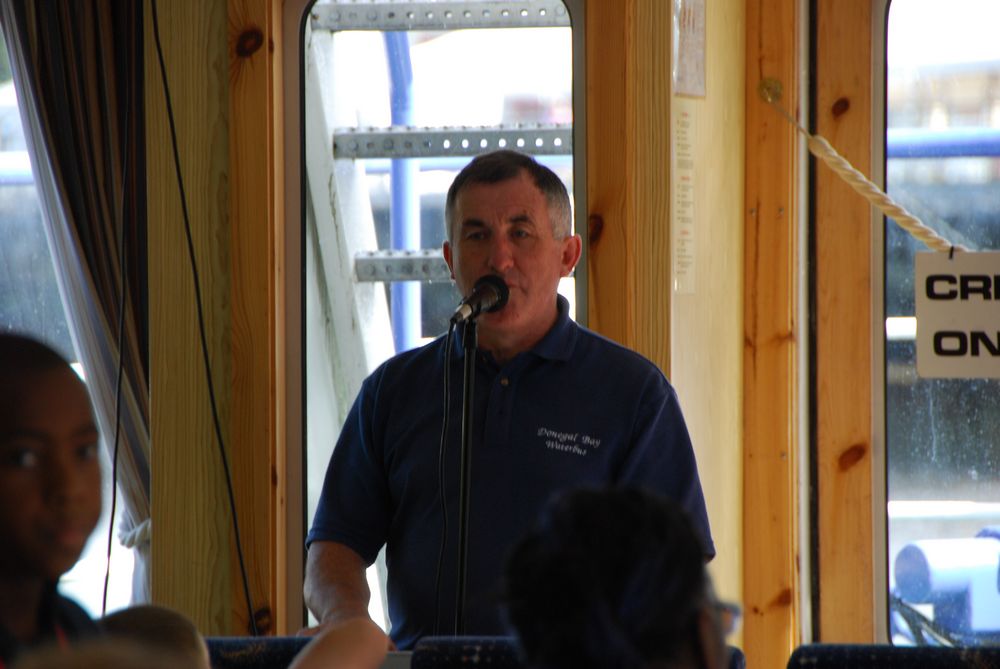
 On the return trip music was playing on the loud speakers and I assumed they were playing a cd until my husband went down to the lower deck to return our glass (we'd shared a Lucozade as carrying two glasses up the narrow stairs might have proven rather difficult!). He arrived back up to tell me that there was actually a man playing an organ and singing. Of course I had to see this and as we were nearly back in Donegal Town, we made our way down to the bar. It was surreal to see people, aboard a "sea safari" singing along with and even dancing to the music!

Our entertainer on the Donegal Bay Waterbus
I'd wholly recommend a trip on the Waterbus whether just to take the fresh sea air, enjoy the fabulous views or for people like us who love taking photographs.  The atmosphere on the boat is great and the staff are friendly, welcoming and helpful.  All I could hear from the passengers disembarking was "brilliant" and "fabulous" and other positive comments.  Walking back along the pier to Donegal Town I spoke with some of the other passengers and every one of them agreed it was a great trip.

THE NITTY GRITTY
NOTE: The Waterbus is dependent on tide times so it is absolutely vital you ring the Waterbus office to check the times the Waterbus will be going out.  Booking a few days in advance is probably best but even on the day you can check with the booking office for availability.

You can't pay on board so you must purchase tickets from the ticket office located at the start of the pier just down the street on the right from the centre of town.

You must have paid and parked FIFTEEN minutes prior to departure time.

PRICES (2010)
Adults ~ €15
Children (4-17 years of age) ~ €5
Student fare (must have student ID card) ~ €10
Group discounts available ~ telephone to arrange these discounts, where applicable, in advance.

To contact Donegal Bay Waterbus:

email: info@donegalbaywaterbus.com
Tel: +353 74 97 24010

To go to their website, click HERE

To view more photographs click HERE

To view a slide show of our trip click HERE